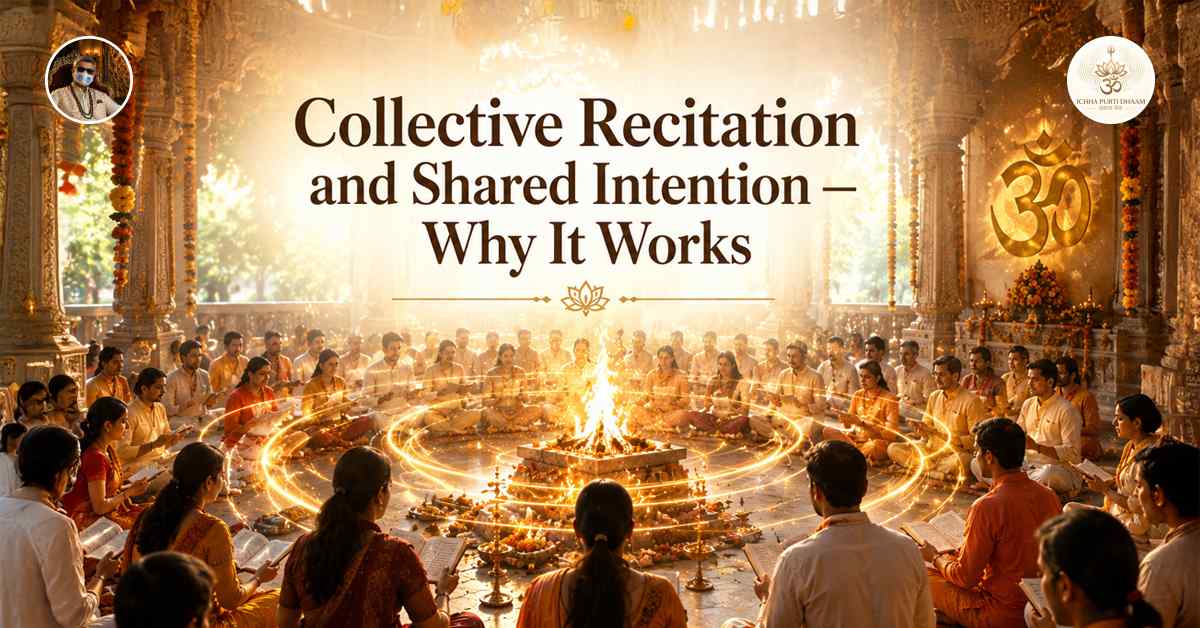
There is something that happens when people recite together that does not happen when they recite alone.
It is not simply a matter of volume or scale. Something shifts in the quality of attention. A rhythm forms. The individual voice merges into a shared field. And in that field, the inner state begins to settle in ways that solitary practice often takes much longer to reach.
Aryaa Maharaj, Adhyatmik Margdarshak rooted in Sanatan Dharma, explains this not as mysticism but as the nature of Spandan — inner vibration, or Urja — when it becomes collective.
Recitation as Energy Practice
Practices like Hanuman Chalisa, Sundarkand Paath, Rudrabhishek, and Chandi Paath have existed in the Sanatan tradition for centuries. They are often understood as religious observances. But in their deeper function, they are structured practices of inner alignment.
Each mantra carries vibration. Each repetition influences breath, slows mental noise, and anchors attention. Individually, this effect builds gradually. Collectively, it intensifies — because the vibrations of those participating begin to synchronise, creating a shared field of Spandan and Urja that each individual alone could not generate.
“Kuch urjaayein akela nahi, saath milkar jagti hain.”
Some energies do not awaken alone. They awaken together.
The Role of Sankalp in Collective Recitation
What distinguishes collective recitation from mere group activity is sankalp — a shared, focused intention held by all who participate.
“Samuhik sankalp vyakti ke sankalp se alag hota hai.”
When multiple individuals hold a similar sankalp, the experience shifts. In that shared field, people often find a calm they could not access alone. A clarity that did not emerge from thinking. A sense of inner quiet that arrives not through effort but through the quality of presence the collective creates.
This is not an immediate or guaranteed outcome. It is a gradual settling. But those who participate in Samuhik Anushthan consistently describe a subtle shift within — something that individual practice alone had not produced.
Why Repetition Is Not Mechanical
Repetition in collective recitation is sometimes misunderstood as mechanical — as if saying the same words again and again is an empty act.
But repetition, in this understanding, is stabilising. Each round of the Chalisa, each aavrit of the Paath, reduces mental noise and deepens the anchoring of attention. What seems like routine gradually becomes rhythm. And rhythm, when shared collectively, creates a field of alignment that extends beyond the individual.
What the Practice Carries Forward
One of the most quietly significant aspects of collective recitation is what it leaves behind after the practice ends.
The session concludes. People return to their daily lives — their work, their relationships, their routines. But something from the collective field tends to remain. A quality of steadiness that was not there before. A slightly greater ease in pausing before reacting. A reduced intensity in situations that would previously have felt overwhelming.
This is not a dramatic transformation. It is a subtle but genuine shift in the inner ground from which daily life is navigated. And over time, as participation in collective practice deepens, this shift accumulates. What begins as a few hours of shared stillness gradually becomes a different quality of inner life.
An Experience, Not an Explanation
The impact of collective recitation is not something that can be fully conveyed through description. It is something to be experienced.
Through Samuhik Anushthan and Yagna, Aryaa Maharaj creates these spaces — online and offline — for individuals to come together in shared practice. Not as a performance. Not as a spectacle. As a genuine field of collective alignment.
Ichha Purti Dhaam, a vision held close to Aryaa Maharaj’s heart for the benefit of all who seek, holds collective recitation and shared intention at its foundation. It is envisioned not merely as a place of individual seeking, but as a living field of Spandan — created by those who gather with a common sankalp.
Through Sankalp Seva, individuals can connect with this field now — before the physical space is complete. Because sometimes a space begins not when it is built, but when it is felt.
“Agar samasya hai to samadhan bhi jarur hoga — aisa mera manna hai.”
Shri Om
Aryaa Maharaj is the founder of Ichha Purti Dhaam — a vision held close to his heart, for the benefit of all who seek. His content series Spandan is available on YouTube. To learn more, visit IchhaPurtiDhaam.com
Recent Posts
Jun 03, 2026